
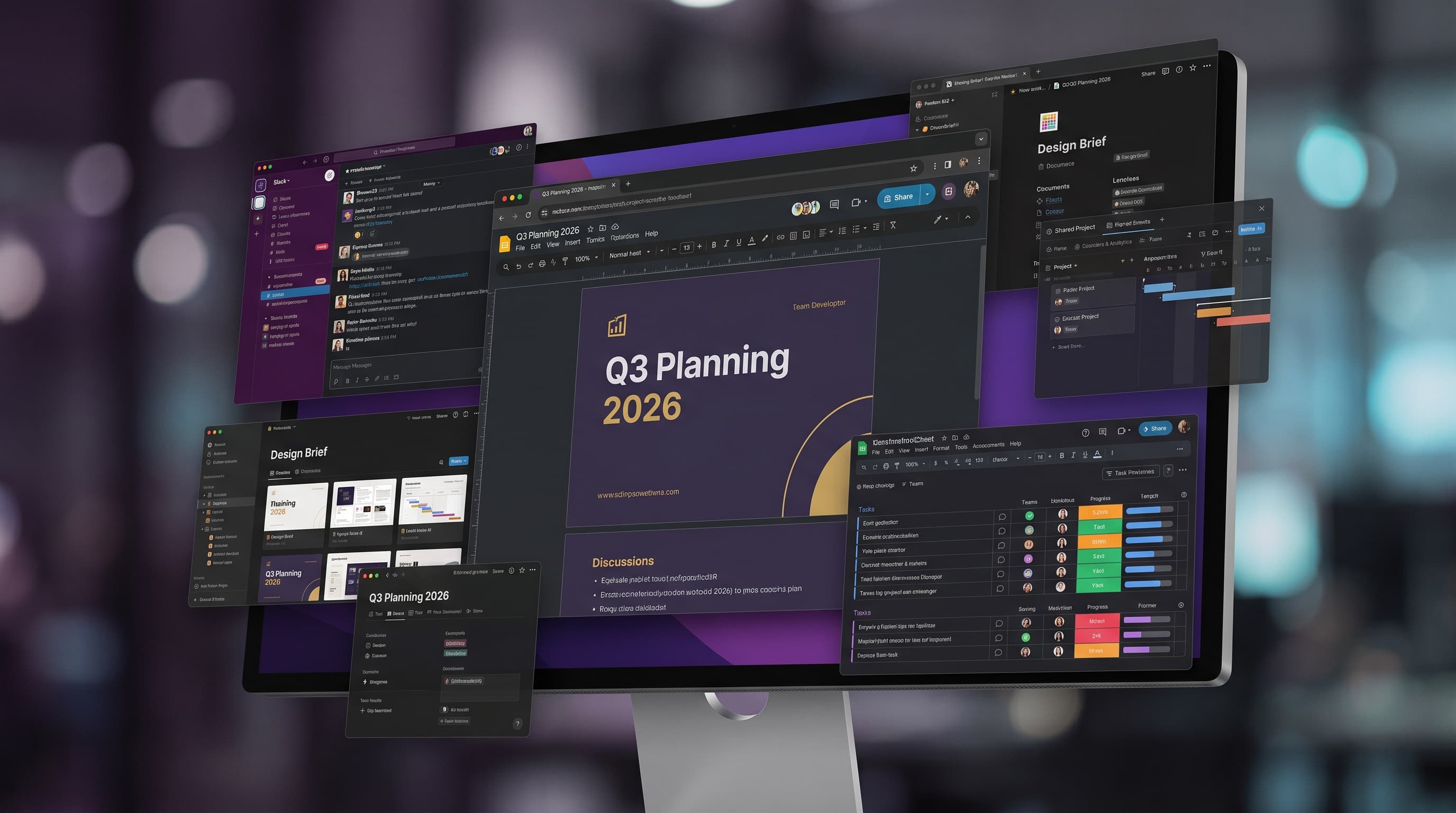
The average knowledge worker switches applications 1,200 times a day. That's not productivity — that's overhead. The highest-performing teams aren't optimising their tool stack. They're replacing it.
You Have Too Many Tools
Count the tools your team uses on a typical Tuesday. Email. Slack. A project manager. A CRM. A document tool. A spreadsheet that's been running your operations since 2019 and nobody fully understands anymore. A scheduling link. An invoicing platform. Possibly a second chat app because a client insisted. An analytics dashboard you check when someone asks for numbers.
If you counted 10 or more, you're not unusual — you're the median. The average knowledge worker switches between applications 1,200 times a day. That's a context switch every 23 seconds across an 8-hour workday.
None of those tools are failing you in isolation. Each one probably does its specific job. The problem is the space between them — where work falls, where context dissolves, where coordination lives.
The Hidden Cost of Context Switching
There are two kinds of cost to tool sprawl. The first is visible: subscription fees, seat licences, onboarding time for every new hire.
The second is invisible — and far more expensive. It's the cognitive tax of switching context. Every time someone moves from the CRM into Slack, from Slack into their task manager, from the task manager into email, they pay a mental re-entry fee. Research from the University of California found that after an interruption, it takes an average of 23 minutes to return to a state of deep focus.
Multiply that across 1,200 daily context switches and you're not dealing with a productivity problem. You're dealing with a structural destruction of focus at every level of the organisation.
“The invisible cost of tool sprawl isn't the subscription fees. It's the 23-minute re-entry tax your team pays 1,200 times a day.”
Why Integration Isn't the Answer
The standard response to tool sprawl is integration. Connect the tools. Add a layer. Zapier this to that. Build an API bridge. Hire a Notion consultant to bring everything into one master dashboard.
Integration eases the symptom without treating the cause. When you integrate 15 tools, you still have 15 tools — now with a 16th tool managing the connections. Every integration is a fragile bridge between two systems that were never designed to work together. When one updates its API, the bridge breaks. When your team grows and needs a new workflow, you bolt on another integration and another bridge.
Integration is maintenance. Orchestration is architecture. They are not the same thing.
The Consolidation Shift
A structural shift is happening in how high-performance teams operate. They're not adding tools — they're collapsing the stack. Moving from a collection of point solutions toward a single execution layer that covers communication, tasks, intelligence, and automation.
This isn't about finding one SaaS to rule them all. It's about moving the operational centre of gravity from a collection of disconnected records to a system that actually runs work. Instead of your team navigating between tools to piece together what needs to happen, the system surfaces the right context, assigns the right agent, and completes the work.
“The highest-performing teams aren't optimising their tool stack. They're replacing it.”
What One System Actually Looks Like
When a business runs on a single orchestration layer, the experience of work changes fundamentally. A new lead arrives. Instead of landing in email, then requiring a manual CRM entry, then a Slack notification, then a task created in Asana — it flows through a single system that routes it, creates the follow-up, updates the record, and notifies the right person in context.
The Friday status update doesn't require someone to pull data from four different tools and paste it into a document. It's generated from the live state of execution.
None of this replaces human judgment. It removes the coordination overhead that currently consumes most of the working day. When the system handles the routing, the records, and the follow-through — your team is free to do the work that actually requires them.
- /Communication and context in one place
- /Task execution, not just task tracking
- /AI agents handling the repetitive layer
- /Real-time intelligence without manual reporting
- /One system — not one more integration