
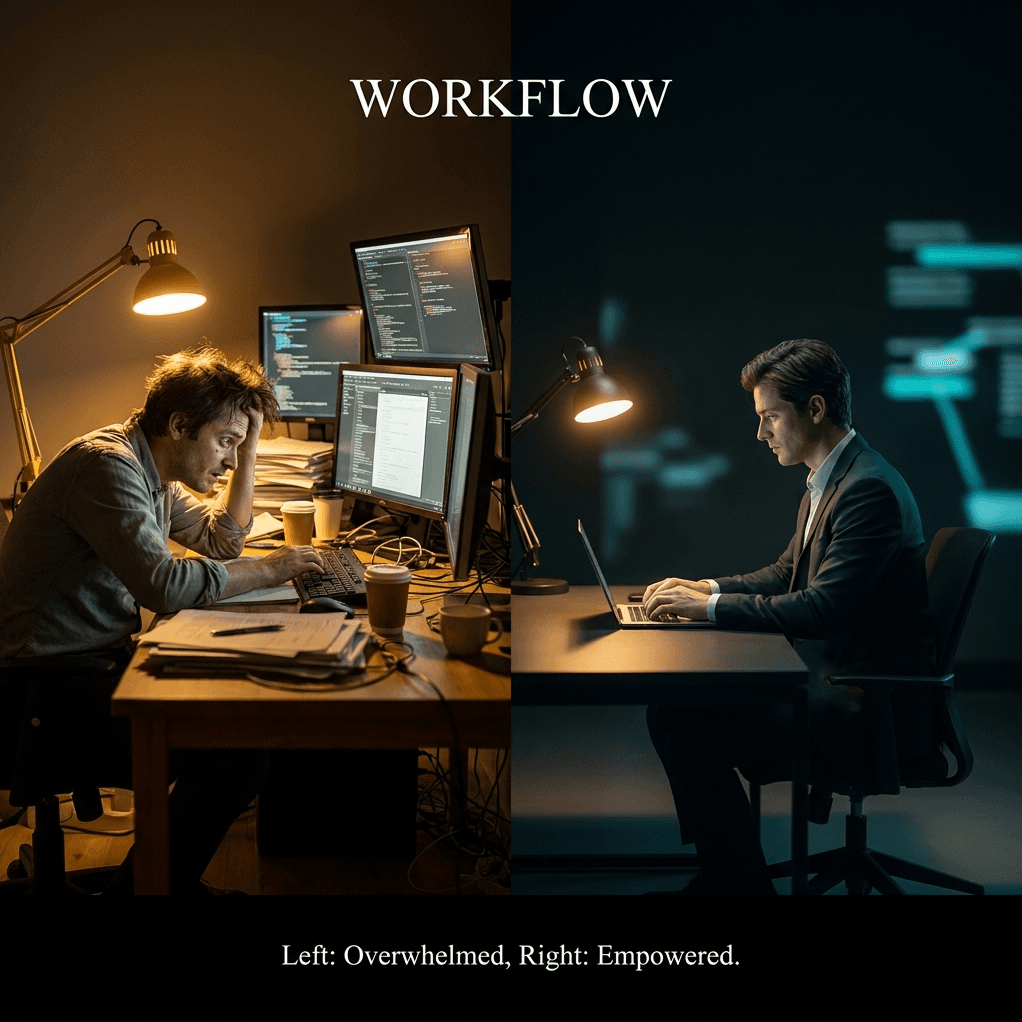
The average SMB runs 12–15 separate SaaS tools and still spends 40–60% of every day on coordination. The problem isn't the tools. It's the absence of orchestration — and fixing it is becoming the defining operational advantage of the decade.
The Fragmentation Problem
The average SMB runs 12–15 separate SaaS tools. A CRM for contacts, Slack for communication, Asana for tasks, Google Drive for files, Zapier to connect them. And yet, with all these tools running simultaneously, most business owners still spend 40–60% of their day on coordination — not execution.
The problem isn't the tools themselves. The problem is that no single system connects them at the level of intent. Your CRM records what happened in a deal, but it doesn't follow up. Your task manager shows what needs to be done, but it doesn't do it. Your communication tool carries the conversation — but the action lives somewhere else, if it gets taken at all.
You don't have a tool problem. You have an orchestration problem.
What Orchestration Actually Means
Orchestration is what happens when a system doesn't just record or display work — it executes it. When a message arrives and an agent routes it, processes it, and resolves it without a human manually coordinating each step.
In music, an orchestra doesn't perform better because each musician has better equipment. It performs better because there's a conductor coordinating every instrument toward a shared outcome. Business orchestration is the same principle applied to your company's operations.
Most tools today are instruments. An orchestration system is the conductor.
“Your CRM records what happened. Your task manager tracks what needs doing. BOS is the system that actually does it.”
From Coordination to Execution
When you replace coordination overhead with orchestration, several things change simultaneously.
First, context stops getting lost. The agent that handled the initial inquiry also holds the follow-up context, the previous notes, and the expected next step. No one needs to relay information between systems.
Second, speed compresses dramatically. Work that required three human handoffs — a message, a check-in, an action — now resolves in a single automated sequence. What took 48 hours takes 4 minutes.
Third, your people stop doing coordination work and start doing judgment work. The follow-up email doesn't need a human to draft it. The CRM update doesn't need a human to enter it. What's left — the strategic decisions, the relationship moments, the creative calls — those still need human judgment. Orchestration clears the path to get there.
The Competitive Moat
Every operational advantage in business eventually commoditises. The companies that adopted email early had an advantage — then everyone had email. The same happened with cloud storage, CRMs, and remote work tooling.
Business orchestration is at the same inflection point right now. Early adopters aren't just moving faster — they're structurally reconfiguring what it costs to operate. When your competitor needs three operations people to manage what you run with one system, the unit economics change permanently.
The moat isn't the technology itself. The moat is the compounding operational lead you build while others are still coordinating manually. Every quarter you operate with orchestration and your competitors don't, the gap widens.
“Early orchestration adopters aren't just faster — they're cheaper to operate. The gap compounds every quarter.”
How to Get Started
The highest-leverage place to start isn't your most complex workflow. It's your most repetitive one. The follow-up email you send every time a lead goes cold. The status update you pull together every Friday. The CRM entry you make after every call.
Pick one process. Automate it completely. See what surfaces when you don't have to touch it. Then expand.
BOS is built to start small and scale to full company orchestration. The first agent you activate won't run your entire company. But it will show you what's possible when you stop coordinating and start executing.
- /Identify your most-repeated manual task
- /Deploy a single agent to handle it end-to-end
- /Measure the time reclaimed in week one
- /Expand to adjacent workflows
- /Graduate to full orchestration across functions